A hand running through long dark hair

K-Tip Hair Extensions and U-Tip Extensions for Fusion Stylists

K-tip and U-tip hair extensions are single strands of human hair finished with a keratin tip at the root end, fused onto the client's hair one strand at a time. The K-tip is flat; the U-tip is U-shaped. Each row you send names one of the two shapes, and its sample comes as loose, unfused strands that your stylist fuses with their own heat tool before you confirm anything.

  • One tip shape per row, named on the sample tag, spec sheet and quote
  • Sample strands arrive unfused, ready for your stylist's usual heat setting
  • Tip shape and seal set against our retained strands before each dispatch
  • Single strands weighed on every K-tip and U-tip row, the result written on the packing list
  • One sales contact for all your keratin tip rows
  • K-Tip and U-Tip Uses — Keratin Fusion Installs for Salons and Stylists

    We supply keratin tip hair extensions in both shapes, the flat K-tip and the U-shaped U-tip, to the stylists who fuse them and to the businesses that keep them in stock for those stylists. Independent extension stylists, hair salons and extension studios order them for fusion installs. Distributors, wholesalers and beauty supply stores carry them for fusion stylists, and private label brands put them out under their own name.

  • A stylist's hand holding a comb and scissors against a client's dark hair

    Independent fusion stylists

    Independent extension stylists who work in fusion use K-tip and U-tip for installs placed strand by strand: a fine section of the client's hair, a keratin tip set against it, the heat tool closed until the tip melts around it. Each strand goes on by itself, so the stylist decides where it sits and how many a client gets.

  • An empty salon with styling chairs and round mirrors

    Hair salons

    Hair salons that offer fusion beside other methods keep their keratin tip rows on one account with their tape-in, wefts or ring-fitted strands, and can add a client number to a row so a returning client is reordered by code.

  • A practice head with long straight copper hair, seen from behind

    Extension studios

    Extension studios with several fusion stylists share one set of rows. Each row names one shape, one strand weight and one pack count, so whoever opens a pack knows the tip and the strand inside it.

  • Shop shelves holding plain boxes in warm light

    Distributors and beauty supply stores

    Distributors and wholesalers stock K-tip and U-tip for the fusion stylists and salons they serve and send their reorders by spec code. Beauty supply stores keep over-the-counter packs for stylists; a store's own SKU can sit on the row as a note, while only the spec code is printed on the pack label.

  • Plain white boxes and a blank card on a grey surface

    Private label brands

    Private label brands sell keratin tip strands in their own packaging. What the brand's stylists approve on the sample becomes the standard for every later order, and the brand's specs and labels serve that brand's orders only.

K-Tip and U-Tip Construction — Strand, Keratin Tip, Your Stylist's Heat Tool

Two parts of a K-tip or U-tip extension come from us. The third, the heat, comes from your stylist.

From us
Loose dark strands of hair lying across a pale surface

The strand

A small lock of human hair cut to the length and weight written on your row. Each row carries one hair type: Remy, with the cuticles kept and lying one way; Virgin, which has never been coloured, permed or bleached; or Raw, collected and sorted, and otherwise processed as little as possible. All the root ends of the lock sit at the tip end.

From us

The keratin tip

The root end of the lock is finished in a keratin tip, in one of two shapes. The K-tip shape is flat. The U-tip shape curves into a U, like a fingernail, so it folds round the client's section during fusion. The end of the tip is closed, holding the hair inside the keratin. Strands and tips are made by our partner workshops to the row we pass to them.

The heat tool

Fusion is done in the salon. The stylist rests the tip against a fine section of the client's hair and closes a heat tool on it, and the keratin melts and closes around the section.

Heat tool + setting · your stylist's own

On our side

On our side, every row carries a spec code and retained strands kept back from the sample you confirmed.

Spec codeRetained strands
Long auburn hair falling down a woman's back, seen from behind
At the chair, the keratin tip is melted with a heat tool onto a fine section of the client's own hair. Your stylist picks the shape that fits the way they fuse, and the row records that shape with its length, hair type, strand weight, pack count, texture and colour.

The heat tool and setting are your stylist's own, and the sample is where they watch the tip melt under that tool and that setting.

K-Tip vs U-Tip — Flat or U-Shaped Tip, One Shape per Row

K-tip and U-tip are one product line with two tip shapes. Hair, row fields and fusion with a heat tool are common to both; the shape of the keratin at the root end is the difference.

K-tip, the flat tip

The keratin at the root end is formed flat. Your stylist lays the flat tip against the client's section and fuses it in place with the heat tool.

Row · [K-tip]-[strand weight]-[colour]
Seen end-on · one fine section of the client's hair
K-tip · lies flat against the section
Showing: after your stylist fuses it with their own tool
Illustration · no heat shown · tool and setting are your stylist's own

U-tip, the U-shaped tip

The keratin is formed into a U, like the curve of a fingernail. As it melts, the U wraps around the client's section of hair.

Row · [U-tip]-[strand weight]-[colour]
  • Two forearms with long light hair falling over them, in black and white

    Your stylist picks the shape

    Fusion stylists build their technique around one shape or the other, so the choice is theirs: the shape their hands and their heat tool are used to. A stylist trained on flat tips writes K-tip rows; a stylist who wraps each section writes U-tip rows. We supply both shapes on the same fields and record the one your stylist names.

  • One shape per row

    A row names a single tip type, K-tip or U-tip. A salon whose stylists work in both writes two rows, even if length, strand weight, hair type and colour are identical. The tip type is written on the sample row tag, the spec sheet and the quote line, and once confirmed each row has its own spec code, so a K-tip pack and a U-tip pack in one shade carry different codes on your shelf.

    Code A · K-tip · [colour]Code B · U-tip · [colour]
  • Both shapes in one sample request

    If your team is still choosing a shape for some of its clients, enter the row twice, as K-tip and as U-tip, with every other field unchanged. The pair is sampled together and arrives as two separate sets, each tagged with its row number. Each stylist fuses the shape they would use, and you confirm one row or both.

  • Switching shape later

    Moving a confirmed row from K-tip to U-tip, or back, changes the structure of the strand. The switch becomes a new row with a fresh sample, while the row you hold keeps its code. To carry the same shade over, the new row is matched to the retained strands of the existing code and made fresh on the other tip, for your stylist to approve.

  • What each shape is judged on

    For both, the tip end should be whole and its shape should match the row: flat for K-tip, a U for U-tip. After fusing, your stylist looks at whether the melted tip has closed around the section of hair.

Keratin Fusion Compared With I-Tip, Nano Tip and Tape-In

Where a keratin tip row sits beside the other attachments we supply:

K-tip and U-tip compared with I-tip, nano tip and tape-in
LineHow the strand attachesWhat your stylist bringsWhat the sample is judged onMoving a row onto K-tip or U-tip
K-TipA flat keratin tip melted onto a fine section of the client's hairTheir own heat tool, at the setting they always useTip end whole and flat, then the fused tip closed around the sectionSwitching to U-tip is a new row, sampled again
U-TipA U-shaped keratin tip that wraps the client's section as it meltsTheir own heat tool, at the setting they always useTip end whole and U-shaped, then the fused tip wrapped around the sectionSwitching to K-tip is a new row, sampled again
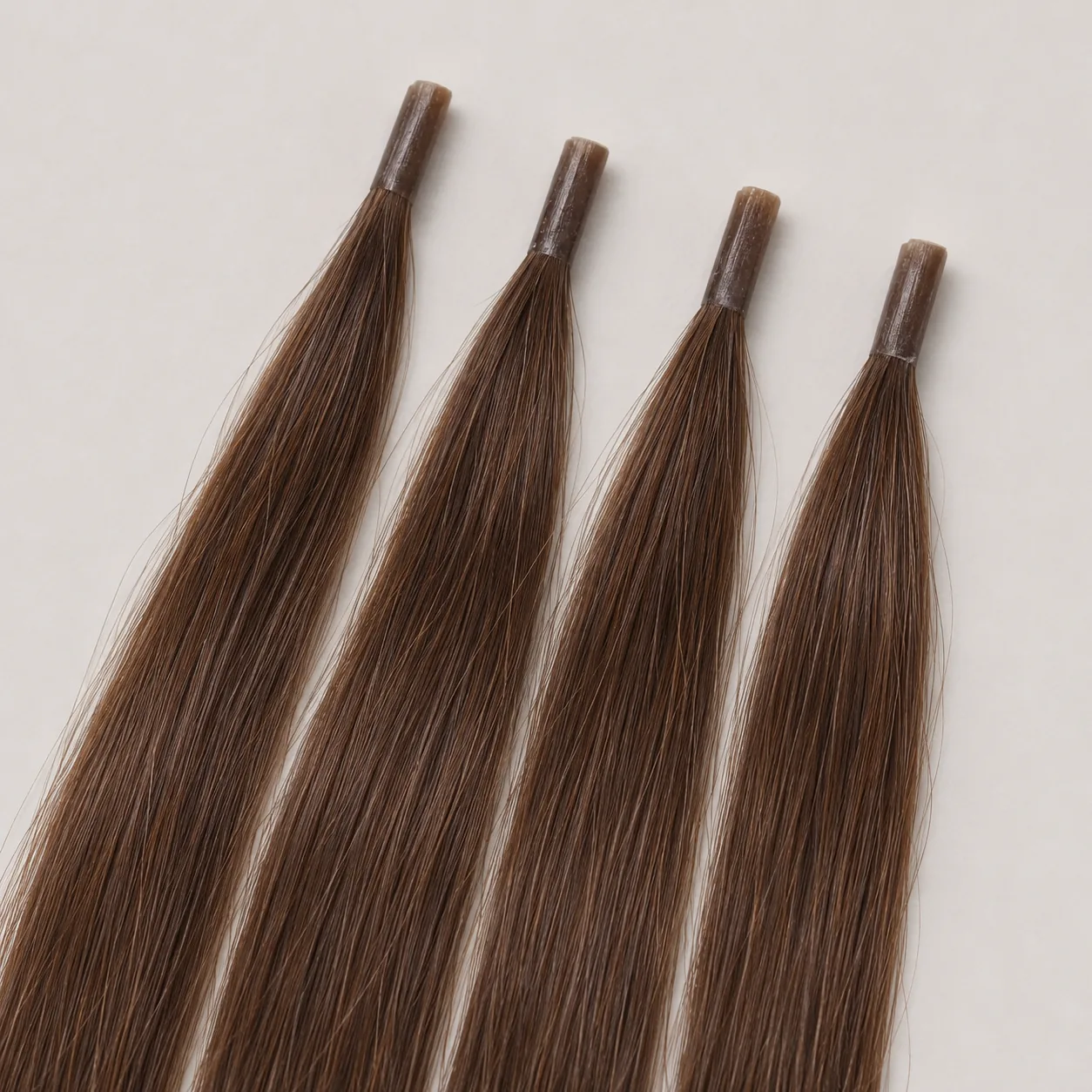
Brown I-tip strands with straight sealed tipsI-TipA straight sealed tip clamped in a micro ring or bead, with no heat or glueMicro rings or beads and pliersTip seal, then the tip after the ring is closed on itA change of line: new row, new sample
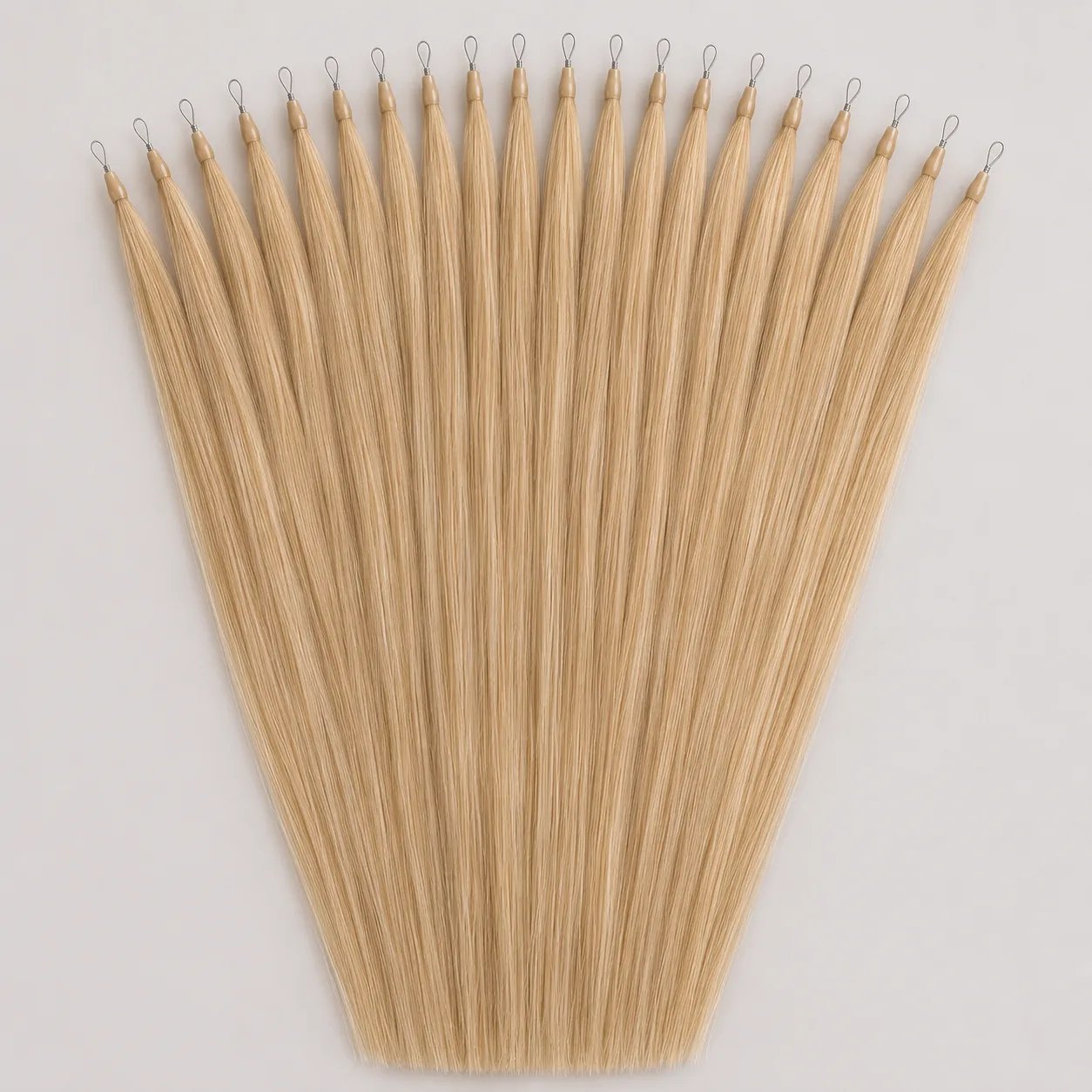
A fan of blonde nano tip strandsNano TipA shorter, finer sealed tip clamped in a nano ring, with no heat or glueNano rings and pliersRing fit, then how ring and tip sit in fine hairA change of line: new row, new sample
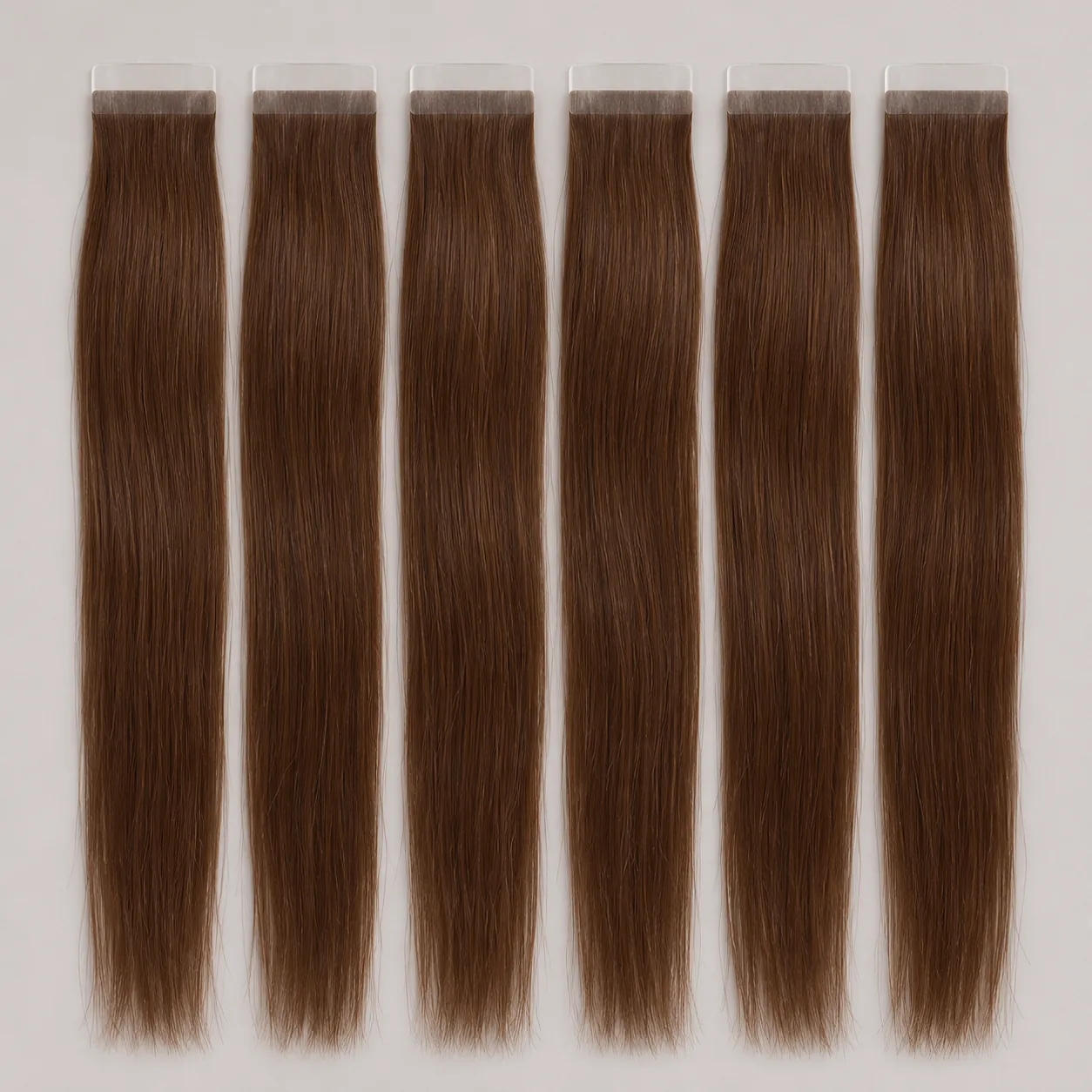
A row of brown tape-in hair panelsTape-InA taped panel pressed onto a section of the client's hairDouble-sided sandwich or single-sided fittingTape edge, panel line and root directionA new row on the keratin tip line, sampled as K-tip or U-tip
A pink notebook and a pen on a grey desk

K-Tip and U-Tip Spec Row Fields

Written on the row · seen on the sample

A row with a blank field is marked and sent back to you, and stays unsampled until it is complete.

K-tip and U-tip spec row fields
FieldHow we record itWhere you see it on the sample
Product lineK-Tip & U-Tip Hair ExtensionsA set of loose keratin tip strands
Tip typeK-tip or U-tip, one per rowFlat or U-shaped tip end on each strand
Strand weightIn grams or ounces, as you write itSingle strands weighed one by one
Strands per packThe count you giveStrands counted in the set
LengthBelow the tip, in inches or centimetres; straight or natural for non-straight rowsMeasured from the base of the keratin tip down
Hair typeRemy, Virgin or RawNamed on the sample row tag
TextureTo your referenceHeld next to the hair you sent
ColourMatched to client hair, your stocked strands or a confirmed codeThe shade on a keratin tip strand
NotesClient number, your SKU, your own colour nameBeside the code on the account spec sheet
Row · [K-tip]-[strand weight]-[strands / pack]-[hair type]-[length]-[colour]
Light blonde hair close up, strands lying side by side
Strand weight
[Your figure] · [your unit]
Strands per pack
[Your count]
Full head
Your stylist's call

Strand Weight and Strands per Pack on Every K/U Row

Each keratin tip row carries two weight figures: what a single strand weighs, and how many strands go in a pack. Both are written your way, in grams or ounces, and both bind the sample and every shipment under that row's code.

A fusion install is many strands fused side by side, so strands of one weight let your stylist space them evenly across the head.

At the sample stage

Your stylist or buyer puts several strands on the scale one at a time, reading each against the row, then counts the set against the pack figure.

Before every shipment

Packs on the row are weighed, as on every line we ship. Strands are then drawn from the row and weighed singly against its strand weight, and the outcome goes next to the row's code on the packing list, as a result rather than individual readings.

Writing a new weight

A different strand weight or pack count becomes a new row, confirmed in writing without a new sample; the confirmed row keeps its code.

How many packs a full head takes is your stylist's call. An amount such as "enough for one client" is broken into rows of one length and one strand weight each, and the quantity goes onto the quote.

A salon counter with shelves of hair products beside an arched doorway

Request K-Tip and U-Tip Samples

Choose K-Tip / U-Tip in the product line list on the sample request form, one row per shape.

K/U Sample Checks — Fused With Your Stylist's Own Heat Tool

A keratin tip row is proven in your salon, on your stylist's tool.

Every row arrives as unfused strands for your stylist to try.

  1. Opened envelopes and scissors on a wooden desk

    What arrives

    One set of unfused strands for every K-tip or U-tip row you asked for. Each set carries a row tag pointing to its line on the spec sheet, tip type included, and it is checked against that row's fields before dispatch. For more than one set of a row, one per stylist for example, write it in the row's note.

  2. A hand held up against warm window light

    First, the tip ends

    Before any heat goes near them, your stylist works through the set looking at each tip end. The end should be whole, with the hair held inside the keratin, and the shape should match the row: flat on a K-tip set, a U on a U-tip set.

  3. A stylist fitting long blonde extensions to a client's hair, seen from behind

    Then, fusion with their own tool

    Your stylist fuses a few strands onto a client's hair or a practice head, with the heat tool they fit with every day, at the setting they normally use. The heat tool and setting are your stylist's own, so the sample is judged under the same conditions as each install that follows.

    Your stylist's toolUsual setting
  4. A stylist's hand resting on a client's long wavy hair, seen from behind

    Then, the fused tips

    Once fused, each tip is looked at for whether the melted keratin has closed around the section it was placed on. On a U-tip row, that includes whether the U has wrapped the section. Your confirmation rests on your stylist's fusion, on their tool, and we make no fusion-test claim for ourselves.

  5. Then, the scale

    Several strands are weighed singly against the row's strand weight, and the set is counted against the pack figure.

  6. Length, texture and colour

    Length is measured below the tip by the method on the row; texture and colour are judged on the same set beside your reference.

Hand this to your stylist

Confirming a K/U Row — Revised Rows, Spec Sheet, Swing Tag

Hands holding a phone up to take a photo
A fabric pouch holding a small notebook on a table

If the set is not right

Mark which row and which field is wrong; your contact turns it into a revised row, and it is sampled again. Until a row is first confirmed there are no approved strands to measure against, so a wrong length or weight at this stage is also sampled again rather than confirmed in writing.

Spec code

On the spec sheet

When the row is confirmed, your contact sends an updated spec sheet showing the row's spec code.

Spec code · [K-tip]-[strand weight]-[colour]

On the swing tag

The code swing tag comes with the row's first bulk shipment, to hang on the approved strands you keep; our retained strands carry the same tag, and each later shipment of the row is held against them.

A two-tone ponytail tied with a pink ribbon, brown at the root and lighter towards the ends, seen from behind

K-Tip and U-Tip Colour Confirmed on a Keratin-Tip Strand

A K-tip or U-tip shade is approved on keratin tip strands. Send a snip of client hair, stocked strands, or the spec code of a shade we have confirmed for you, and the sample set is made to it. A client snip is cut from the inner layer, where it does not show, root to end, with the root end taped and marked with the client number and row; your contact gives the address.

A shade confirmed on another line

A shade confirmed on tape-in, a weft, bundles, I-tip or nano tip becomes a new keratin tip row. It is matched against that code's retained sample and made new on K-tip or U-tip strands, because the shade has to be seen on the new structure before your stylist approves it.

A low ponytail, dark at the root and honey-blonde at the ends, seen from behind

Highlights or two tones

A client with highlights or two tones gets one row per colour, each sampled separately, and the stylist blends the strands at the chair. Shade numbers from colour charts stay as notes beside the colour field, which is written from the physical hair you send.

Short dark hair with bright highlights at the crown, seen from behind
Made fresh on K-tip or U-tip strands · for your approval
A basket of sectioning clips and brushes against an orange wall

K/U Shipment Check — Tip Shape, Seal and Strand Weight Before Dispatch

Every row

Each K-tip and U-tip row on an order is checked, whether it ships on its own or inside a mixed order across several lines.

  • Tip shape and seal

    Strands from the row go beside the retained strands held under its code. We compare the shape, flat for K-tip and U for U-tip, and the seal at the tip end, where the hair should sit inside the keratin.

  • Strand weight

    Packs are weighed, then strands are taken from the row and weighed singly against its strand weight.

  • Length, colour and texture

    Checked by the four-point routine every line follows, set out on our home page.

  • No heat, no pulling

    Shipment strands are neither fused nor pulled, so every strand you fit or resell reaches you with its keratin tip untouched.

  • Packing list and labels

    Each row's tip result and single-strand weight result are written against its code, with the code on every pack label.

A row that does not match

It stays back. You get photos from us, and the row is redone to its confirmed spec before it ships. If other rows are ready, you decide whether they go first or wait for it.

After arrival

Weigh a few strands from a pack and lay the tips next to the approved strands your stylist fused. If a row looks wrong, send photos with its spec code; we reply with a photo of our retained strands for that code beside yours, and settle the handling of that row with you.

A hand holding up a phone to photograph a lake

Changing a K/U Row — Tip Shape, Line, Strand Weight, Colour

Changing a confirmed K-tip or U-tip row means writing a new row. The confirmed row keeps its code, so you can go on ordering it while the new one is settled. What settles the new row depends on what changes:

A pencil point over a sheet of paper
  • Sampled again

    Tip shape, K-tip to U-tip or back

    A structural change, sampled again and fused by your stylist before confirmation.

  • Sampled again

    Fusion to rings, or rings to fusion

    Moving between K-tip or U-tip and I-tip or nano tip is a change of line, sampled again on the new line.

  • Confirmed in writing

    Strand weight or strands per pack

    Confirmed in writing, no new sample.

  • Confirmed in writing

    Length only

    Confirmed in writing, no new sample.

  • Sampled again

    Colour or texture

    Sampled again against the reference you name.

  • Sampled again

    Hair type

    Sampled again.

Existing codes and new rows can go on one reorder sheet, each under its own rule, and you choose whether the codes ship at once or wait for the new rows. Reordering by code across every line is explained on Wholesale Hair Extensions.

K-Tip and U-Tip Quote Checklist — Rows, Shapes, Packs, Destination

Rows that hold a code can be quoted in our first reply; codes and quantities are enough. New rows show on the quote as pending sample confirmation until your stylist approves the sample.

A sample tagged with its spec row

Your account

  • Your company and buyer type
  • Destination
  • Repeat plan: rows you expect to reorder

Each keratin tip row

  • Each keratin tip row: tip type (K-tip or U-tip), strand weight, strands per pack and length below the tip, in your units
  • Hair type for every row: Remy, Virgin or Raw
  • Colour: client hair, stocked strands or a confirmed code
  • Texture: hair we can match
  • Estimated quantity per row

Notes, optional

  • Notes (optional): client numbers, SKUs, your own colour names

Private label brands add their packaging direction and label files before the first quote, and keratin tip rows can join any other line through Build a Mixed Order.

A loose blonde braid seen close up from behind

Send Your K-Tip and U-Tip Rows

Send your rows with the form below or on WhatsApp, naming the tip shape on each. Request Samples brings unfused strands for your stylist to try; Get Wholesale Quote covers rows that already hold codes.

What do you need?
Please enter your name.
Please enter an email address the reply can go to.
Please enter your company name.
Please choose your buyer type.
Please describe at least one K-tip or U-tip row, or a spec code.
The reply goes to the email address you give, with a spec sheet for your keratin tip rows.
A long dark ponytail seen from behind in a dim, shaded walkway